Product introduction
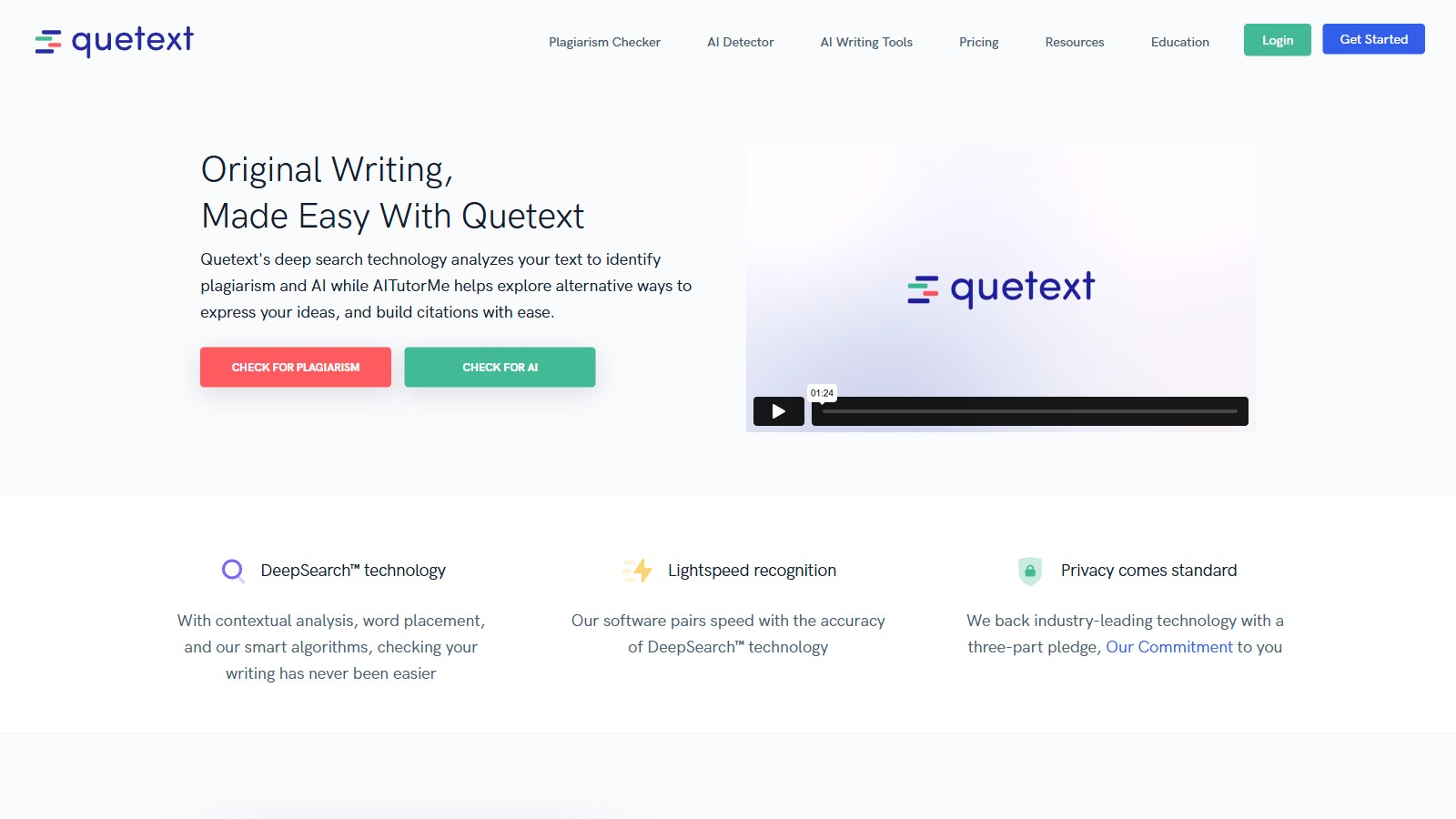
Launched in 2012, Quetext is a professional online plagiarism detection and writing assistance platform serving students, writers, and publishers worldwide. Powered by its proprietary DeepSearch™ deep semantic comparison engine, the tool performs high-speed scans across massive databases containing billions of web pages, academic papers, journals, and books to accurately identify various forms of non-originality, including direct copying, paraphrasing, patchwriting, and self-plagiarism.
Beyond core similarity checking, Quetext integrates an AI content detector, the smart rewriting assistant AITutorMe, an automatic citation generator, and grammar/spell check modules. This provides a one-stop solution for improving writing quality from issue identification to resolution. The platform supports 14 languages, offers color-coded feedback and PDF report exports, and is compatible with Google Drive and OneDrive for batch uploads. Quetext promises not to store user documents, ensuring comprehensive privacy security for both academic and commercial documents.
Key Features
- DeepSearch™ Semantic Plagiarism Detection: Combines contextual semantic analysis, fuzzy matching algorithms, and conditional scoring mechanisms to precisely locate complex plagiarism forms such as direct copying, indirect paraphrasing, text patching, and self-plagiarism.
- AI Content Generation Detection: Analyzes text features line-by-line to effectively identify content generated by mainstream large language models like ChatGPT, GPT-4, and Bard, providing specific confidence percentage assessments.
- AITutorMe Smart Rewriting: Offers one-click rewriting services that generate three high-quality rewritten versions based on the original meaning, reducing similarity rates while enriching expression diversity.
- Automatic Citation Format Generation: Features a powerful citation generator supporting major academic formats like APA, MLA, and Chicago. It automatically fills in missing information and inserts citations into the text, significantly reducing formatting errors.
- Visual Color-Coded Feedback: Uses red, orange, and green colors to intuitively distinguish between highly similar, vaguely similar, and original content, helping users quickly pinpoint sections requiring revision.
- Batch Processing & Team Collaboration: Supports uploading 20 to 100 files at once. Team members can collaborate on reviews via online annotations and conveniently download plagiarism reports in PDF format.
Use Cases
- Academic Paper Compliance Review: University students perform full-text plagiarism checks and AI detection before submitting papers to ensure compliance with institutional academic integrity standards.
- Journal Submission Pre-screening: Editors and reviewers use the batch upload feature to rapidly screen large volumes of manuscripts, promptly identifying potential plagiarism or AI-generated content issues.
- Teacher Assignment Grading: Teachers create class shared links to uniformly collect student assignments and provide online annotated feedback, enhancing teaching management efficiency.
- Content Marketing SEO Optimization: Marketing teams verify originality before publishing blogs or whitepapers to avoid search engine penalties caused by duplicate content.
- Publisher Copyright Protection: Scans manuscripts against web resources during the final book preparation stage to prevent unintentional infringement and generate authoritative copyright verification reports.