Product introduction
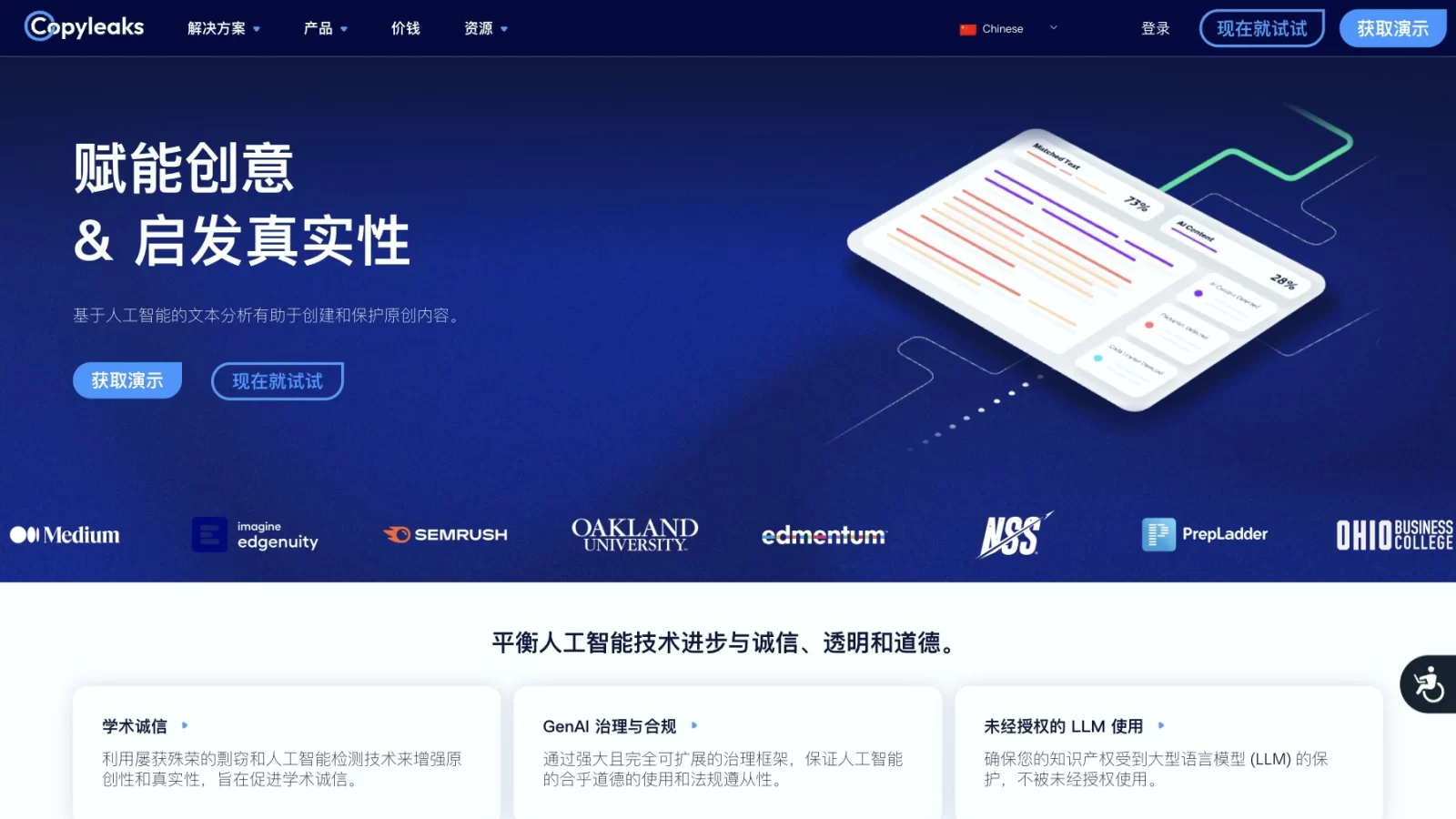
Founded in 2015, Copyleaks is a technology service provider dedicated to digital content security and copyright protection. Leveraging its proprietary AI engine, the platform offers an all-in-one solution for educational institutions, enterprise clients, and the publishing industry, ranging from plagiarism detection to AI-generated content identification, aiming to maintain content originality and authenticity.
Its core product lines cover multiple dimensions including text, code, and grammar. These include an AI content detector, traditional plagiarism comparison tools, source code review modules, and a grammar checking assistant, helping various users effectively manage content compliance risks in digital environments.
Key Features
- High-Precision AI Detection: Identifies text generated by mainstream large language models such as ChatGPT and Gemini. Official data indicates an accuracy rate of up to 99.1% with a false positive rate as low as 0.2%, ensuring high detection precision.
- Hybrid Content Analysis: Accurately distinguishes and marks the proportion of human-written versus AI-generated text, enabling transparent detection even when both types are mixed.
- Multi-Language Support: The system supports detection in over 30 languages, including English, Chinese, Spanish, and French, catering to global user scenarios.
- Code Security Auditing: Features unique capabilities to identify AI-generated code traces within programming languages and provides related code license compliance assessments.
- Enterprise-Grade Data Privacy: Strictly adheres to international information security standards such as GDPR, SOC 2, and SOC 3, ensuring the security and privacy of uploaded user data.
Use Cases
- Academic Integrity Management: Universities and educational institutions can use this tool to screen student papers and assignments, identifying potential AI ghostwriting or plagiarism to uphold academic standards.
- Enterprise Content Risk Control: Brands and enterprises can audit the originality of marketing copy, technical documentation, and other published materials, mitigating risks such as search engine penalties associated with unmarked AI content.
- Publishing Quality Control: Publishers and content creators can verify the origin of submitted works, filtering out low-quality AI-generated content to maintain the professional reputation of media brands.
- Model Data Cleaning: AI research teams can use this tool to filter training data, removing non-human-authored samples to improve the final model's training effectiveness and quality.