Product introduction
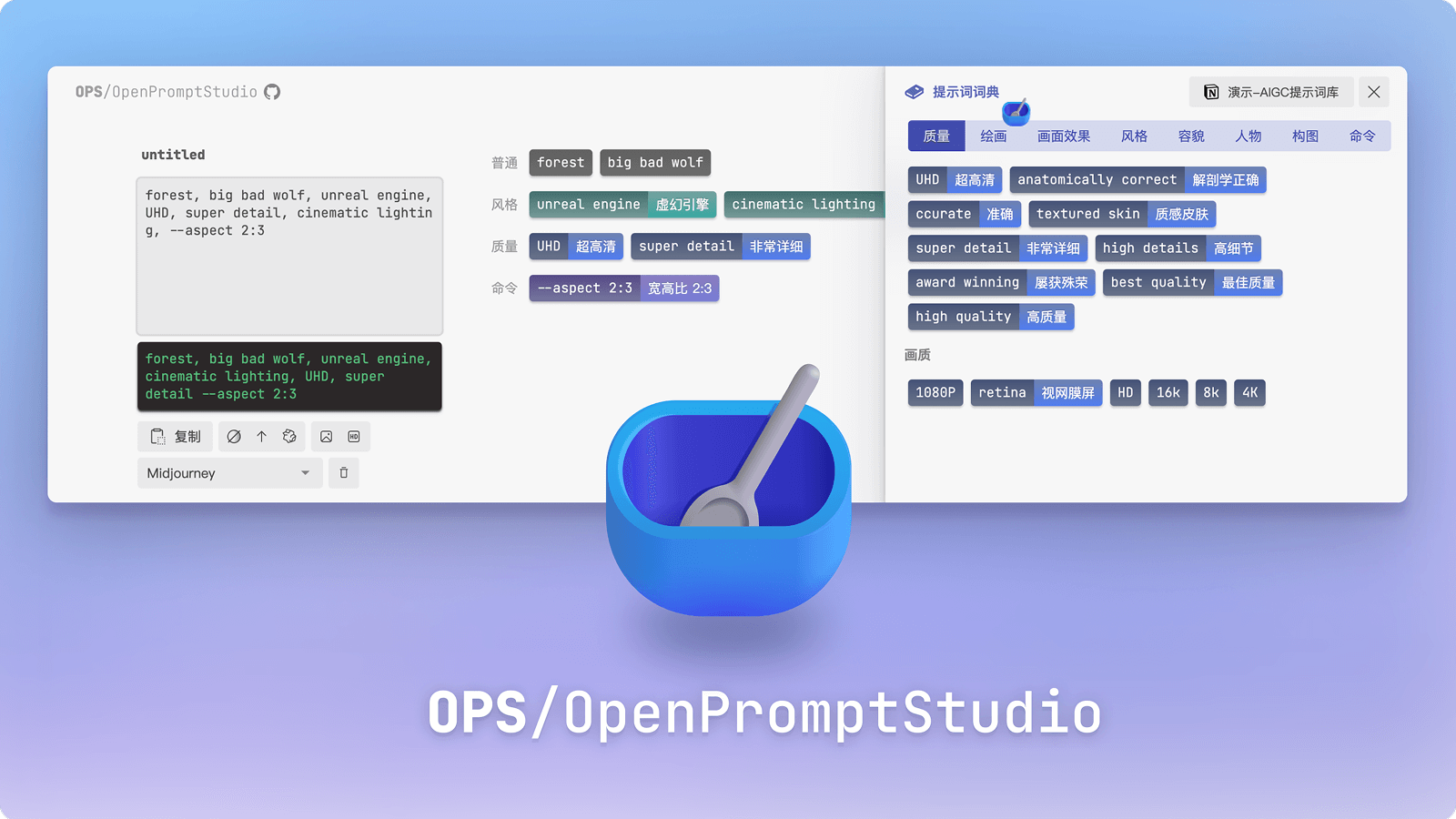
Open Prompt Studio (OPS) is an open-source visual management tool for AIGC prompts, developed by the Moonvy team. It primarily targets users of AI art platforms like Midjourney and Stable Diffusion. The tool addresses the pain points of non-English speakers in constructing complex prompts by breaking down cumbersome English instructions into draggable, editable modular components through an intuitive interface.
As a completely free open-source project, OPS supports both online usage and local deployment to ensure data privacy. Its core highlights include intelligent Chinese-English translation capabilities and deep integration with Notion databases, helping users efficiently manage their personal prompt libraries and optimize the entire workflow from creative conception to final generation.
Key Features
- Visual Module Editing: Uses a drag-and-drop interface supporting parallel processing of multiple prompt groups and weight fine-tuning, with real-time preview of combined effects.
- Intelligent Language Conversion: Built-in translation engine automatically converts Chinese descriptions into professional English terminology compliant with AI art model standards, lowering language barriers.
- Preset Keyword Library: Includes categorized dictionaries for image quality, artistic style, composition perspective, and special effects rendering, supporting one-click access to standardized tags.
- Notion Ecosystem Integration: Synchronizes with Notion databases; users can bind API keys for cross-device access and classified management of personal asset libraries.
- Flexible Open-Source Deployment: Fully open-source code allows developers to customize secondary features, such as connecting to private translation interfaces, meeting scenarios with high data security requirements.
Application Scenarios
- Rapid Onboarding for Beginners: Helps creators unfamiliar with English prompt syntax quickly generate high-quality prompts using Chinese input and preset templates.
- Team Collaboration Standards: Design teams use shared Notion databases to unify style terminology and keyword libraries, improving consistency and efficiency in collective creation.
- Personal Asset Accumulation: Creators classify and archive commonly used and validated prompt fragments into Notion, forming a reusable personal style asset library.
- Teaching and Demonstration Aid: Teachers or trainers use the visual structure to intuitively demonstrate the impact of keyword weights on image generation, facilitating knowledge transfer.
- Foundation for Custom Development: Developers extend functionality based on the open-source architecture, such as integrating more AI models or building enterprise-level prompt management systems.