Product introduction
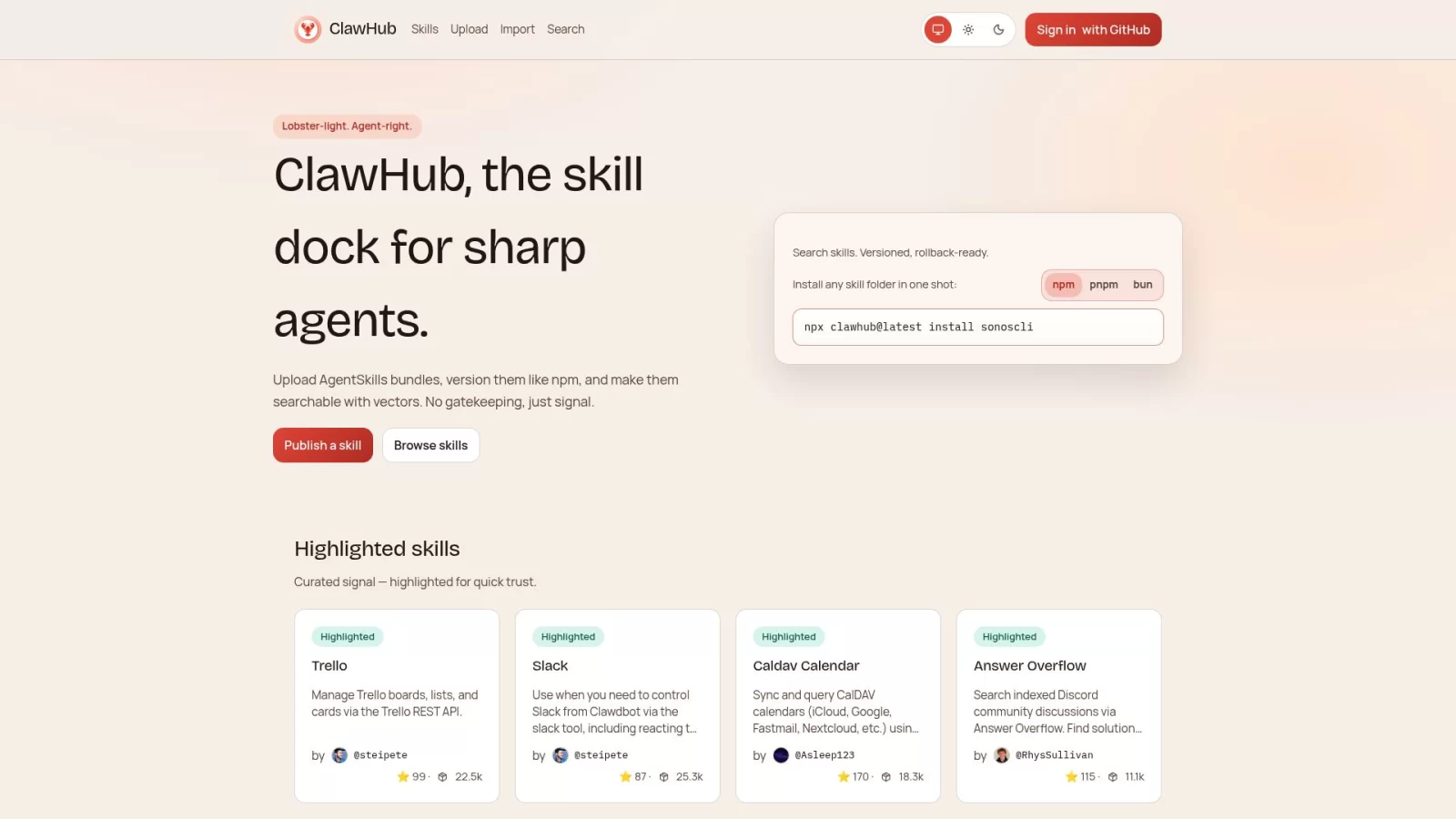
As the core hub of the OpenClaw ecosystem, ClawHub serves as the "central nervous system" for AI agents. It aims to bridge the gap between the underlying reasoning capabilities of Large Language Models (LLMs) and actual business execution. If OpenClaw provides the "brain" that enables AI to understand and think, ClawHub offers a comprehensive "tool belt," covering everything from social media integration to cloud resource management.
The platform is essentially a skills marketplace where developers can share and deploy executable Markdown scripts or code using the standardized SKILL.md format. These skills break the limitation of AI being restricted to conversation, enabling it to directly interact with third-party applications like Slack, Gmail, and WhatsApp, perform data scraping, send emails, and automate cross-platform workflows, thereby transforming AI technology into practical productivity tools.
Key Features
- Semantic Skill Retrieval and Management: Equipped with a powerful semantic search engine, it allows users to precisely locate required skills through natural language descriptions. Users can install, update, and manage loaded skills with a single click via CLI tools, significantly lowering the barrier to expanding AI capabilities.
- Standardized Skill Packaging Architecture: Built on the SKILL.md specification, skill packages integrate documentation, metadata, and executable logic into a single Markdown file. This structure facilitates developer review, customization, and modification of skill logic while ensuring clear and flexible deployment.
- Multidimensional Security Audit Mechanism: Integrates the VirusTotal code insights engine to scan for malicious code and analyze behavior, providing security ratings of "benign," "suspicious," or "malicious." It also supports manual review via local priority security checklists and version locking to prevent destructive changes or security risks introduced by automatic updates.
- Multi-Model and Cross-Platform Connectivity: Natively supports the integration and management of mainstream large models such as Claude and GPT, and unifies API call scheduling through platforms like APIYI. Additionally, it deeply integrates with instant messaging channels like WhatsApp, Telegram, and Slack to enable cross-platform message automation.
Use Cases
- R&D Process Automation: Combined with GitHub integration and code review skills, AI agents can automatically monitor Pull Request activity, fetch code changes, invoke LLMs for review, and automatically post results as comments, significantly reducing manual review costs.
- Cross-Channel Information Synchronization: Message processing skills break down barriers between different platforms. For example, automatically extracting new articles from Telegram channels to generate summaries and sync them to Slack, or automatically retrieving knowledge base responses when receiving technical inquiries via WhatsApp, achieving seamless information flow.
- DevOps Infrastructure Operations: Dedicated DevOps skills automate Docker container building, Kubernetes cluster management, and AWS resource scheduling. Under strict permission controls, these skills simplify complex operational tasks and improve infrastructure management efficiency.
- Personal Knowledge Management and Office Efficiency: By connecting with productivity tools like Google Workspace, Notion, and Obsidian, it enables functions such as email summarization, automatic calendar addition, and quick note retrieval. Users can use natural language commands to have AI assist in organizing yesterday's emails or creating Notion pages, optimizing daily workflows.
- Model Performance Comparison Testing: Using model access skills, users can parallelly invoke different models such as Claude 3.5 Sonnet and GPT-4o within the same environment to process identical tasks, automatically generating comparison reports to assist in selecting the optimal model solution.